Parsnips
Type: Vegetable
Rotation Group: 2, Roots and Onions
 | | GLADIATORHas rapidly established itself as a leading variety, which is no surprise. It has long tapering, wedge-shaped roots with smooth white skin. The roots have a really sweet flavour and are resistant to canker. It is quick to establish after germination and remains vigorous. |
 | | TENDER AND TRUEStill a very popular long variety with very little core, noted for its lovely flavour. Large rooted, traditional type, an excellent parsnip with high quality tapering roots with some resistance to canker. Maturing time approximately 32-36 weeks from sowing. |
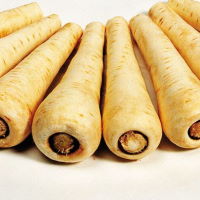 | | COUNTESSThe sweetest parsnip, it is high yielding and disease-tolerant, it gives a fine crop of uniform, smooth skinned pure white roots. Reliable in a variety of soils and seasons and has a very good taste and texture. Maturing time approximately 32-36 weeks from sowing. |
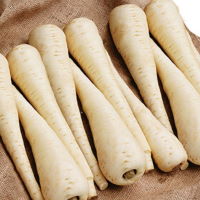 | | JAVELINA British-bred variety with smooth skinned roots of very good flavour, excellent for roasting. It is a very flexible variety being one with the latest sowing time on the market. With a last sowing date of around the 3rd week in May. It has good canker-resistance. |
Site, Soil and Preparation
Parsnips prefer an open, sunny site with deep, light soil.
Indoor Sowing
Parsnips should be sown direct outdoors.
Outdoor Sowing
Sow seeds thinly, or sow three at 150mm (6in) intervals, 13mm (1/2in) deep, in rows 300mm (1ft) apart.
Thinning
When seedlings are about 25mm (1in) high, thin out to leave one every 150mm (6in).
Transplanting
Transplanting is not necessary when sown outdoors.
Care
Keep the soil weed free, hand weeding rather than hoeing close to the plants, to avoid damaging the top of the root. Keep the soil evenly moist to prevent roots splitting.
Harvest
The roots are ready to lift when the foliage starts to die down in late summer or autumn. Use a garden fork to carefully ease them out of the ground.

