Onions - Pickling
Type: Vegetable
Rotation Group: 2, Roots and Onions
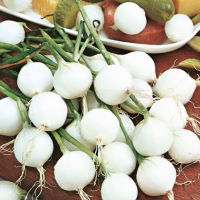 | | PARIS SILVERSKINParis Silverskin are an easy to grow, dual purpose onion. If you like a good size bulb on "spring" onions pull them young or leave to mature and crop as small onions for pickling. This way they can be pickled for use in summer salads or added whole to winter stews. Delicious! |
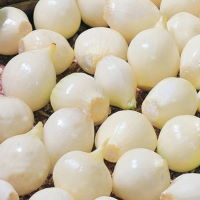 | | ONION DE PARISOnion de Paris gives a delicious crop of small, rather flat, white-skinned bulbs which are perfect either for pickling or adding to casseroles or salads. It has a good, full flavour. |
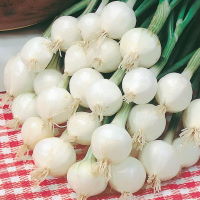 | | POMPEIA quick-growing round white onion which is equally delicious for salads or pickling. |
Site, Soil and Preparation
Onions thrive in an open, sunny position and on fertile, well-drained soils.
Indoor Sowing
Sow onion seeds 12mm (1/2 in) deep in seed compost in a greenhouse kept at 10-16 centigrade in middle to late winter. Sow in module trays with a half dozen seeds in each module for later thinning.
Outdoor Sowing
Onion sets are easier to grow than growing from seed and can be planted outside in autumn or in spring. Push them into the soil so the tip is just showing at 100mm (4in) spacings in rows 300mm (12in) apart.
Seeds can also be sown outdoors from the middle of spring - once the soil is warming up and beginning to dry out. Sow 12mm (1/2in) deep in rows 200mm (8in) apart.
Thinning
Thin indoor grown seeds to 2 or 3 per module.
Thin outdoor sowings gradually to the strongest seedlings at 100mm (4in) spacing.
Transplanting
Indoor sown onions should be hardened off before transplanting outside to final growing position at 100mm (4in) spacing in rows 300mm (12in) apart, in the middle of spring.
Care
Weed regularly, as onions don't grow well if competing with other plants. Water in prolonged dry spells every 14 days, and give an occasional feed with a general liquid fertiliser. But stop watering and feeding once the onions have swollen in mid-summer. Remove any flower stems as soon as they start to form, otherwise the plant's energy will go into producing the flower, rather than swelling the bulb.
Harvest
Autumn-planted sets are ready to harvest by early to mid-summer, while spring-sown or spring-planted onions are ready in late summer to early autumn. Yellowing and toppling of the leaves is a sign that the crop is reaching maturity. Harvest before the leaves die down completely.

